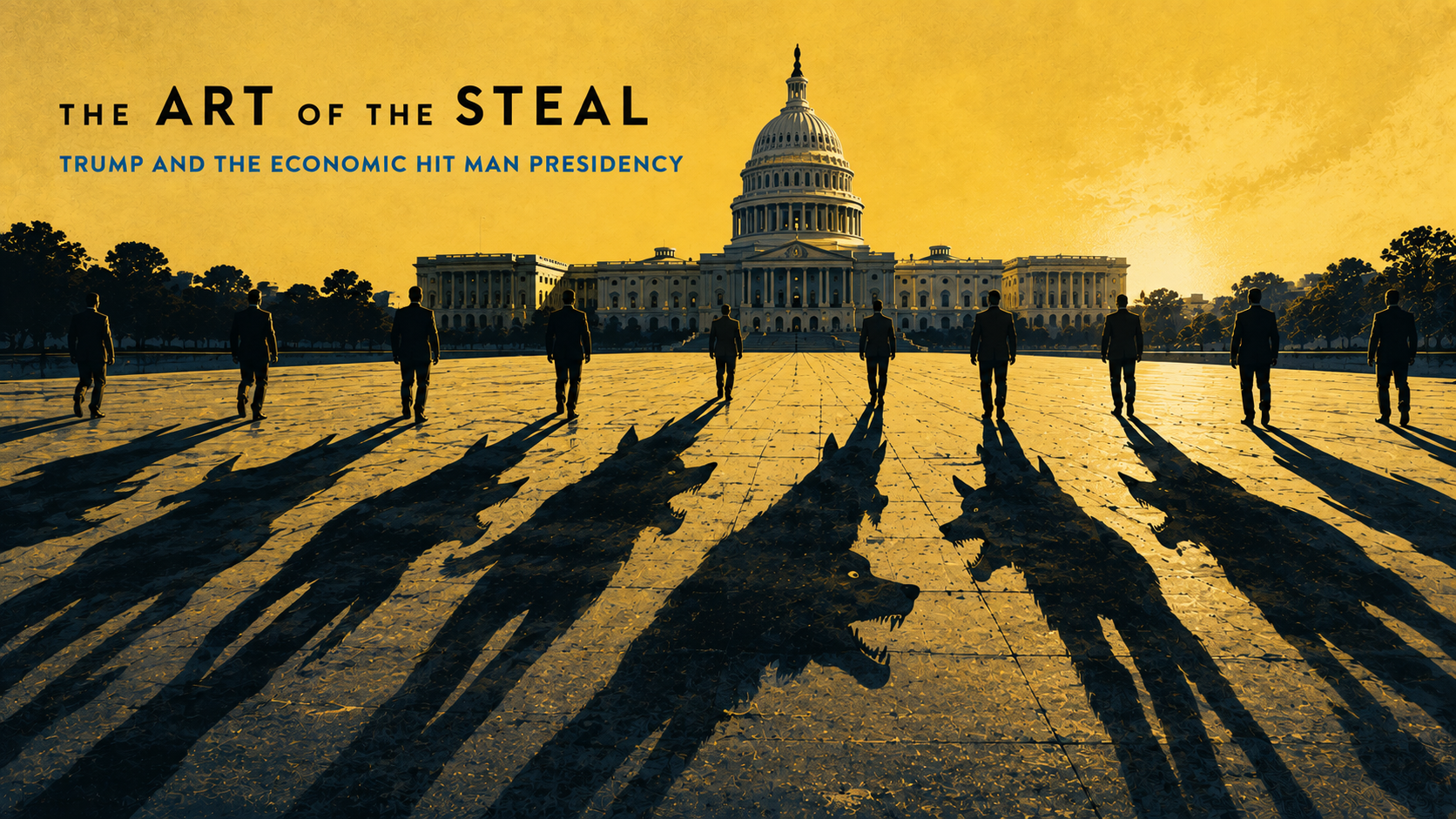
“When economic tactics fail, send in the jackals.” That was the rule behind the work I once did overseas. First came promises, debt, fear, seduction, and coercion. If those economic hit man methods failed to bring a country under control, violence followed. For years, most Americans could believe this system belonged to distant places and operated beyond our borders.
I once believed that, too. No longer. The methods I used abroad have turned inward, and the consequences have destroyed many of our institutions and divided our communities. In this excerpt from my upcoming book The Art of the Steal, I explain how the economic hit man system came home to the United States, and why recognizing that system is the first step toward changing it.
This book is not just about Donald J. Trump. Yes, his name appears throughout these pages and in the subtitle. But he is merely a symbol of how the economic hit man (EHM) strategy has evolved, regardless of which political party occupies the White House. It has taken over the US presidency.
Other countries are led by economic hit men, including the two with the largest nuclear arsenals after the United States: Russia and China. However, the United States is unique in that it has served as a beacon for democracy during most of the past 250 years. The other countries have long histories of governments that are openly autocratic.
When I wrote the first edition of Confessions of an Economic Hit Man in 2004, I never expected to see the techniques I’d used in distant countries deployed so openly inside my own country—and by the US government itself. I never imagined that the beacon of democracy could be eclipsed by the dark veil of oligarchy. I never guessed that a US president would openly praise and mimic autocrats like Russia’s Putin, China’s Xi, and Hungary’s Orbán.
That book exposed a strategy that operated in the shadows behind the beacon. It created a system that is backed by powerful corporate, financial, and political interests. Our economic hit man tools included fraudulent financial reports, inflated promises, questionable elections, manufactured fears, corruption, coercion, sex, threats of retribution, and even assassinations. The goal was to control the planet's resources and funnel money into the coffers of huge corporations and the pockets of a few wealthy families. It was the art of the steal painted as legitimate.
In the years since, the economic hit man system has metastasized. It no longer limits itself to economically vulnerable nations. It has also turned inward. As president, Trump has mastered the art of the steal and displayed it for all to see.
Trump’s frequent dismissal of scientific consensus, hostility toward experts, and politicization of education and research has taken a toll on institutions that every previous administration has championed. He rejects a principle that was established in the United States 250 years ago—that progress is driven by rational debate and evidence-based decision-making. His leadership style emphasizes loyalty over law and strength over cooperation. His aggressive nationalism, public threats toward other nations, and withdrawal from multilateral agreements demonstrate a preference for domination and unilateral action rather than shared global problem-solving.
Trump defined the nature of his economic hit man presidency during the first day of his second term as president. On January 20, 2025, he granted blanket clemency to the nearly sixteen hundred people convicted of or awaiting trial for assault and other crimes committed during the January 6, 2021, attack on the US Capitol. At least 140 police officers were injured, and one later died. A number of other officers died by suicide in the months following the incident.
Although those clemencies and the many actions that followed in 2025 shocked the world, they were superseded during the first weeks of 2026. In the first and second months of the second year of Trump’s second term, he took actions that raised global outrage: deploying a massive military force into Venezuela, sending thousands of heavily armed federal troops to Minneapolis, threatening to take over Greenland, and attacking Iran.
Trump justified the Venezuelan operation as necessary for ending the rule of the country’s self-proclaimed president. He justified the Minneapolis operation by threatening to invoke the Insurrection Act and calling people who protested the killing of US citizens by ICE agents “domestic terrorists.” He justified his determination to own Greenland as part of his national defense strategy, claiming that US control is essential to counter Russian and Chinese interests in the Arctic.
It soon became apparent that these were more than attempts to overthrow a government, disperse protesters, and occupy territory. They were dramatic symbols of the president's use of the EHM strategy: When economic tactics fail, send in the jackals.
Preorder The Art of the Steal: Trump and the Economic Hit Man Presidency.