It’s time for another newsletter. But I just returned from speaking at a series of exhausting (and inspirational) events in San Francisco, Istanbul, and New York City. I’m jet-lagged, and talked out.
My inbox to the rescue!
In it, I found an essay by my longtime collaborator Samantha Thomas, who created the Love Summit and hosted it with me. She writes about the time I asked a room of business leaders to imagine aliens looking down at what we’re doing to our planet and to one another. It seems more important now than ever, so here it is:
Change the Dream
John Perkins spent ten years persuading countries to take on enormous loans. Then the Achuar told him to go home and change the dream behind them.
By Samantha A. Thomas, originally published on Just Choose Love
On the second morning of the 2017 Love Summit, at LPK in Cincinnati, John Perkins asked a room of businesspeople to put their feet flat on the floor and close their eyes.
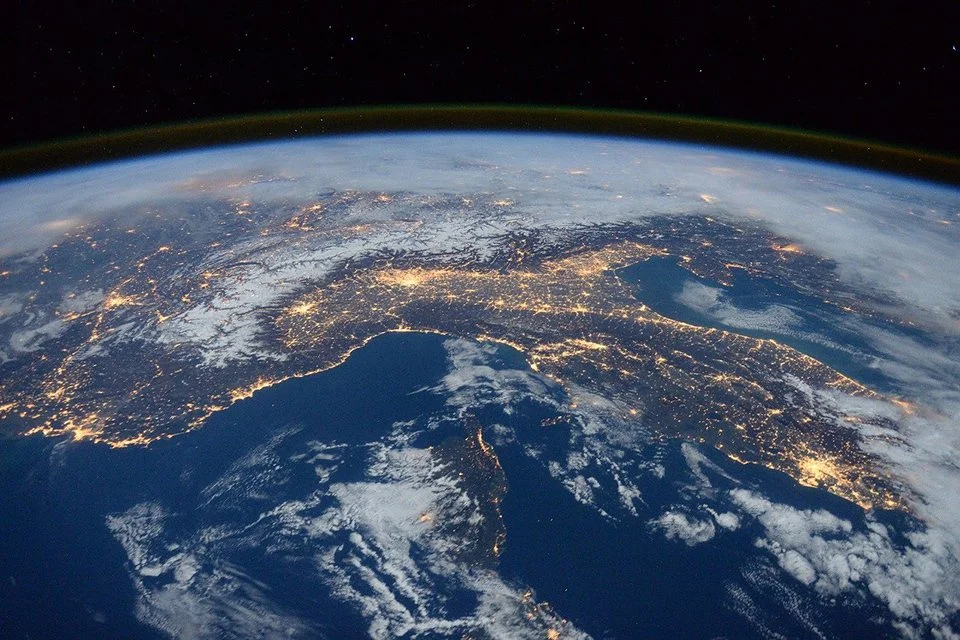
He began by grounding the room: the chair beneath each person, the floor beneath the chairs, and the earth beneath the building, which he called by its Andean name, Pachamama. Then he took them up, high above the planet, and asked them to imagine they had come from another solar system and were hovering there, looking down.
What they saw, in his telling, was a beautiful planet with abundant resources, and a species doing shocking things to it. Human beings brutalizing one another. Human beings destroying the very resources they depend on. He asked the room what they would feel, watching that from above, and what they might eventually decide to do about it.
Then he brought everyone back to their seats, waited for them to open their eyes, and grinned. “What a hell of a way to start a conference,” he said.
The aliens, he told them, were real, and they were coming. Not from another solar system, but out of the laboratories of Google and Amazon and the startups some of the people in that room were building. Every expert he had talked to agreed, he said: within twenty years, artificial intelligence would be smarter than we are, and it would be watching us and asking what on earth we were doing here.
That was nine years ago.
This is the last essay in my series from the Love Summit archives, and I wanted it to be John’s. I created the Love Summit in 2015 with John and our board at Dream Change, the organization he founded. He hosted both gatherings with me. At the second one he didn’t give a keynote. He gave the opening remarks, seventeen minutes on the morning of day two, and when I went back to them this fall I found nearly everything this series has been about, folded into one short talk: perception and power, the economy and the earth, and the question of what we let love run.
Two Realities
John came to all of this through an unusual door for an economist. In the late 1960s, fresh out of business school, he was a Peace Corps volunteer in the Ecuadorian Amazon. He got very sick there, and he credits an Indigenous healer with saving his life. In return, the healer asked John to become his student.
“There was no future in shamanism,” John said, to laughter. But he spent years afterward learning from Indigenous teachers on several continents, and he summed up what they taught him in one word: perception.
There are two realities, he said. There’s the objective one, the microphone in his hand. And there’s the perceived one, the words he was speaking into it. Human life is shaped almost entirely by the second. There is no United States or Canada, no religion, no corporation, no economy, except as we perceive them. But once enough people accept a perception and write it into law, it has an enormous effect on the objective world. We perceive borders, and so borders shape our lives.
Philosophers have a name for this. John Searle called them institutional facts: money, borders, marriages and corporations, which exist only because enough of us agree they do, and are no less real for it.1
Then he told the room what he had done with that knowledge. For about ten years he worked as what he later called an economic hit man, persuading the leaders of developing countries to take on enormous loans for infrastructure built by American corporations, on the promise, as he tells it, that everyone would be better off. He described it as work he’d been trained to do, and very good at, and he wrote about it in Confessions of an Economic Hit Man.2
Eventually he quit and went back to the Amazon, wanting to help save the rainforest. The people there told him the rainforest wasn’t theirs to save. The destruction came from the oil companies and the lumber companies, they said, and behind those, from a dream, by which they meant the picture of a good life a whole society shares: big buildings and heavy industry and lots of cars. That dream had served a purpose, but it was out of balance. Go home, they told him, and help your people change the dream.
That’s where Dream Change came from. John took the Achuar’s instruction, turned it around, and made it the name of the organization he founded. Later, with Bill and Lynne Twist and others, came the Pachamama Alliance.3 And it’s where, decades later, the Love Summit came from too.
A Death Economy and a Life Economy
John has a gift for compressing a large argument into a sentence a room can repeat. In business school before the mid-1970s, he said, he was taught that a good CEO earns a decent return for investors and also takes good care of employees, customers, suppliers, and the community. A good company paid its taxes and gave money to the local schools.
He tied the change to Milton Friedman, who won the Nobel Prize in economics in 1976 and is best known in business circles for arguing, in The New York Times Magazine, that the social responsibility of business is to increase its profits.4 Over the following decades, John said, that idea hardened into something narrower: maximize short-term returns for shareholders, whatever the social and environmental consequences.
He called the result a death economy, a system consuming the planet it depends on. What the people in that room were working toward, he said, was a life economy, one that pays people to regenerate damaged land, clean up pollution, and invent technologies that don’t ravage the earth.
That argument has moved since. Two years after John spoke, in August 2019, the Business Roundtable, whose members lead many of the largest companies in America, issued a new statement on the purpose of a corporation. One hundred eighty-one CEOs signed it, committing to deliver value to customers, invest in employees, deal fairly with suppliers, and support their communities, alongside generating long-term value for shareholders.5 Whether companies have lived up to it is a fair and open question. But the perception John was describing had started to shift, in writing, at the top.
The Bird in Mating Season
The heart of John’s remarks was a story from the month before the Summit. He was in the Amazon with the Achuar, the people whose invitation in 1995 began the Pachamama Alliance, and he was walking with a hunter who carried a blowgun.
The hunter raised the blowgun toward a bird in the branches, aimed, and then lowered it without shooting. John asked him what happened.
The bird was in its mating season, the hunter said. No matter how hungry his children were that day, if he killed it now, its young would not be born, and his children’s children would be hungrier for it later.
That night they sat around the fire, and the hunter told John that all of it was about love. He loved the bird. The bird eats the insects, his family eats the bird, and there is a cycle that holds them all.
“I won’t kill anything that doesn’t give me permission. And that bird, because I know it’s in mating season, has not given me permission.”
Permission is a word we usually reserve for people. He extended it to a bird, and through the bird to a future he would never see. That’s love as restraint, the kind that looks past what you want today toward the people and creatures who will live with your choice. It’s also a different dream from the one the Achuar sent John home to change. That one told a whole society it could take the forest’s oil and timber. The hunter’s begins by asking what it has permission to take.
It’s also sound economics. Elinor Ostrom won the Nobel Prize in economics in 2009 for showing that communities around the world have kept forests, fisheries and pastures healthy for centuries through rules like the hunter’s, about when and how much to take, which they made and enforced among themselves.6
It also runs through this series. Judy Wicks refused to open a second restaurant, because growing deeper in one place mattered more to her than growing wider. Sarah Severn and Darcy Winslow spent years inside Nike asking what was in the shoes and who would breathe it. Each of them, in their own way, was asking whether they had permission.
Run by Love
Before he left the stage, John had the whole room say a line back to him, twice: “The world is run by business. Businesses must be run by love.”
I’d widen that line a little now, and I think John would agree. Business runs a great deal of the world, and it’s where many of us spend our working lives. But so do our cities and our governments, our schools and hospitals and the institutions we inherit without ever choosing them. The hunter’s question belongs in all of them. What are we taking that hasn’t given us permission? And who will live with the consequences after we’re gone?
John closed with a line often attributed to Michelangelo:
“I saw the angel in the marble and carved until I set her free.”
The angel in the marble of business is love, he told the room, and we were all there to carve. “We’re coming really close to her,” he said. “She’s about to leap out.”
I love that he was optimistic. He had just come back from speaking in Rome, Russia, Kazakhstan (I was with him there, and heard it too), and across Latin America. Everywhere he went he heard the same thing: people waking up to the fact that we live on a small, fragile space station and could be taking much better care of it. He described it as a shift in how people understand their responsibility to one another and to the planet, and he said we were lucky to be born into it.
What It Will See
So, back to the aliens.
John asked that room to imagine a greater intelligence looking down at us, and to ask what it would make of what it saw. Nine years later, we’re building those intelligences ourselves, and we’re teaching them from what we’ve written and recorded and done. Whatever they come to understand about human beings, they will learn from us: from our arguments and our decisions, and from how we treated one another and the world we depend on.
That makes John’s question less hypothetical than it sounded in 2017. It also makes it hopeful. The record isn’t finished. Every decision we make about how we lead, how we build, and how we use the power we have is part of what we leave behind for whoever, or whatever, comes next.
That’s the work the Love Summit was created for, and it’s where this publication turns now. In the weeks ahead, I’ll be sharing new recorded conversations with people who are trying to bring love into the places where decisions are made, as we build toward gathering again in person in 2027. Thank you for reading these ten essays with me. Some of you were in those rooms, and many of you found your way here through them.
And finally, here is the question I’d ask you, the hunter’s question:
In the place where you lead, or the community you’re part of, what are we taking right now that hasn’t given us permission?
Subscribe to read more from Samantha.
Endnotes
- John R. Searle, The Construction of Social Reality (Free Press, 1995).
- John Perkins, Confessions of an Economic Hit Man (Berrett-Koehler, 2004).
- Pachamama Alliance, “Origin Story.” The alliance began in 1995 at the invitation of Achuar elders, who asked its founders to help “change the dream of the modern world.”
- Milton Friedman, “The Social Responsibility of Business Is to Increase Its Profits,” The New York Times Magazine, September 13, 1970. Friedman’s own formulation added a condition: “so long as it stays within the rules of the game, which is to say, engages in open and free competition without deception or fraud.” His 1976 Nobel Prize was awarded for work on consumption analysis and monetary history and theory.
- Business Roundtable, “Statement on the Purpose of a Corporation,” August 19, 2019.
- Elinor Ostrom, Governing the Commons: The Evolution of Institutions for Collective Action (Cambridge University Press, 1990). Ostrom shared the 2009 Nobel Memorial Prize in Economic Sciences with Oliver Williamson.